
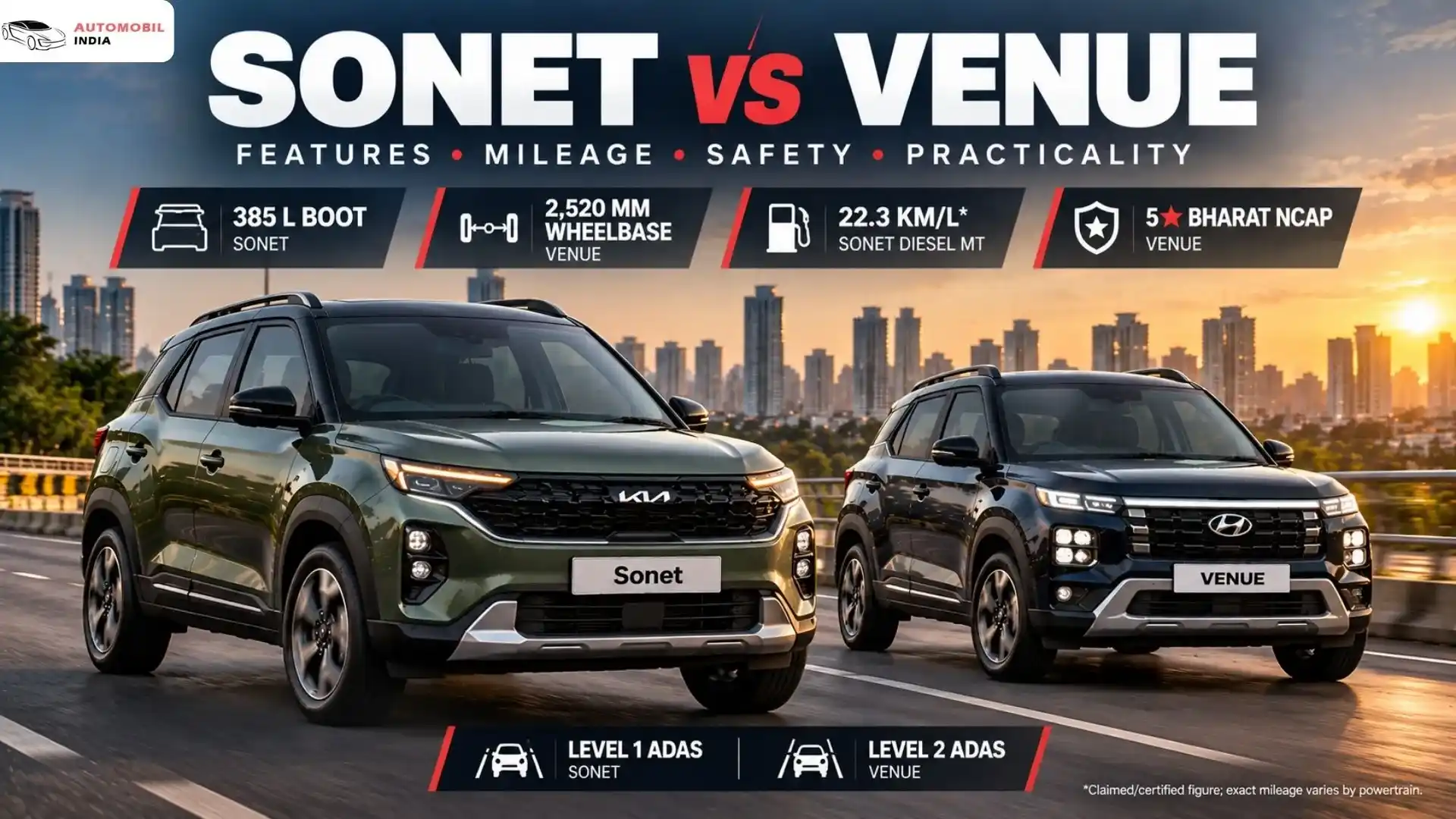
The Kia Sonet and Hyundai Venue are two of India's most established compact SUVs, but the 2026 comparison has become more interesting after the arrival of the all-new Hyundai Venue.
Both SUVs offer multiple petrol and diesel engines, manual and automatic transmissions, strong feature lists and six airbags. However, they now have noticeably different strengths.
The Kia Sonet stands out for its wide powertrain choice, compact dimensions, 385-litre boot and features such as ventilated seats, a 360-degree camera and Level 1 ADAS on higher variants. The new Hyundai Venue is larger than before, offers a 2,520 mm wheelbase, Level 2 ADAS and has earned a 5-star Bharat NCAP rating.
So, Sonet vs Venue is no longer simply a choice between two similarly sized feature-rich SUVs. The right option depends on whether you prioritise compact city dimensions, engine/gearbox choice, technology, rear-seat space or independently tested safety.
Kia Sonet vs Hyundai Venue: Quick Comparison
|
Parameter |
Kia Sonet |
Hyundai Venue |
|
Starting ex-showroom price |
₹7.40 lakh* |
₹7.99 lakh* |
|
Length |
3,995 mm |
3,995 mm |
|
Width |
1,790 mm |
1,800 mm |
|
Height |
Up to 1,642 mm |
1,665 mm |
|
Wheelbase |
2,500 mm |
2,520 mm |
|
Boot space |
385 litres |
375 litres |
|
Petrol engines |
1.2L NA, 1.0L turbo |
1.2L NA, 1.0L turbo |
|
Diesel engine |
1.5L diesel |
1.5L diesel |
|
Maximum petrol power |
120 PS |
120 PS |
|
Maximum diesel power |
116 PS |
116 PS |
|
Petrol automatic |
7DCT |
7DCT |
|
Diesel automatic |
6AT |
6AT |
|
Claimed maximum mileage |
Up to 22.3 km/l |
Up to around 20.36 km/l depending on powertrain/variant |
|
Airbags |
6 standard |
6 standard |
|
ADAS |
Level 1, 10 functions |
Level 2 |
|
360-degree camera |
Available |
Available |
|
Bharat NCAP |
No current rating |
5 stars |
|
Seating |
5 |
5 |
*Starting prices are manufacturer-listed ex-showroom prices and can change by variant, location and applicable pricing revisions. Kia currently lists the Sonet starting at ₹7,40,900 after the GST-related price revision, while Hyundai lists the new Venue from ₹7,99,900.
Sonet vs Venue Price: Which Is Cheaper?
The Kia Sonet has the lower starting price.
Kia currently lists the Sonet from ₹7,40,900 ex-showroom, while Hyundai lists the all-new Venue from ₹7,99,900 ex-showroom.
That gives the Sonet an entry-price advantage of roughly ₹59,000 before registration, insurance and other on-road costs.
However, comparing only the base price can be misleading.
The Venue and Sonet have large variant ranges, and the engine, gearbox and equipment combination can change the price substantially.
Current Sonet variants
Kia lists eight main Sonet trims:
-
HTE
-
HTE(O)
-
HTK(O)
-
HTK+
-
HTK+(O)
-
HTX
-
GTX+
-
X-Line
The higher GTX+ and X-Line variants add features such as Level 1 ADAS, a 360-degree camera, ventilated seats, a 10.25-inch digital cluster, 10.25-inch touchscreen, Bose audio and a powered driver's seat.
Current Venue variants
The new Venue uses Hyundai's HX naming structure, with variants ranging from HX2 to HX10, along with Knight editions and the separate Venue N Line range.
The important buying lesson is simple:
Compare the exact engine + transmission + variant rather than just comparing the starting prices.
Sonet vs Venue Engines and Performance
Both SUVs give buyers three broad powertrain choices.
Kia Sonet
The Sonet offers:
-
1.2-litre naturally aspirated petrol
-
1.0-litre turbo-petrol
-
1.5-litre diesel
The 1.2-litre petrol produces 83 PS and 115 Nm, while the 1.0-litre turbo produces 120 PS and 172 Nm. The 1.5-litre diesel produces 116 PS and 250 Nm.
Transmission choices include:
-
5-speed manual
-
6-speed iMT
-
7-speed DCT
-
6-speed automatic
The diesel is particularly versatile because it is available with both manual and automatic transmission options.
Hyundai Venue
The new Venue also gets:
-
1.2-litre naturally aspirated petrol
-
1.0-litre turbo-petrol
-
1.5-litre diesel
Hyundai lists the 1.2-litre petrol at 83 PS and 114.7 Nm, the 1.0-litre turbo-petrol at 120 PS and 172 Nm, and the 1.5-litre diesel at 116 PS and 250 Nm.
The available transmissions are:
-
5-speed manual
-
6-speed manual
-
7-speed DCT
-
6-speed automatic
Which is quicker?
On paper, the turbo-petrol and diesel versions are almost evenly matched.
Both turbo-petrol engines produce 120 PS and 172 Nm, while both diesel engines produce approximately 116 PS and 250 Nm.
Therefore, the performance difference is unlikely to be decided by the headline engine numbers.
The more meaningful difference is how each vehicle's engine, gearbox calibration, weight and chassis work together in actual driving.
Sonet vs Venue Mileage: Which Is More Fuel Efficient?
Mileage depends heavily on the exact engine and gearbox, so there is no single number for either SUV.
For the Sonet, currently listed certified figures include approximately:
|
Sonet Powertrain |
Claimed Mileage |
|
1.2 Petrol MT |
18.83 km/l |
|
1.0 Turbo iMT |
18.7 km/l |
|
1.0 Turbo DCT |
19.2 km/l |
|
1.5 Diesel MT |
22.3 km/l |
|
1.5 Diesel AT |
Around 18.3–19.3 km/l depending on variant |
The Venue's current certified figures vary by powertrain and variant. Current industry listings put the petrol range around 18.3–20.36 km/l, with the diesel reaching around 20.36 km/l in the relevant configurations.
Which one has better mileage?
If your priority is maximum certified mileage, the Sonet diesel manual has the stronger published figure at around 22.3 km/l.
But this does not mean every Sonet will be more economical than every Venue.
The important comparison is:
Same fuel + similar transmission + similar usage.
For city driving, a naturally aspirated petrol may make more sense than choosing a diesel purely for its headline mileage if your annual running is low.
For frequent highway driving, the diesel versions of both cars become much more compelling.
Sonet vs Venue Dimensions: Which Is Bigger?
The two SUVs have exactly the same overall length at 3,995 mm, but the new Venue is wider, taller and has a longer wheelbase.
|
Dimension |
Kia Sonet |
Hyundai Venue |
|
Length |
3,995 mm |
3,995 mm |
|
Width |
1,790 mm |
1,800 mm |
|
Height |
Up to 1,642 mm |
1,665 mm |
|
Wheelbase |
2,500 mm |
2,520 mm |
This is one of the most important changes in the current Sonet vs Venue comparison.
Although both remain under four metres long, the new Venue has a 20 mm longer wheelbase and 10 mm more width.
What does that mean?
The Venue's longer wheelbase gives Hyundai more scope to improve rear-seat legroom.
Its new-generation cabin also gets wider doors, additional legroom and two-step reclining rear seats. Hyundai specifically highlights the increased cabin space and 2,520 mm wheelbase.
The Sonet remains the more compact-feeling SUV.
That can be useful if you frequently drive through:
-
Narrow urban roads
-
Crowded parking areas
-
Older city neighbourhoods
-
Tight apartment parking spaces
Which Has More Boot Space?
This is an interesting reversal.
Despite the Venue being longer in wheelbase, the Sonet currently has the larger claimed boot.
Boot capacity
-
Sonet: 385 litres
-
Venue: 375 litres
Kia lists 385 litres, while Hyundai lists a 375-litre boot for the new Venue.
The 10-litre difference is not enormous, but it can still matter when carrying luggage.
For a family that regularly carries:
-
Two medium suitcases
-
Shopping bags
-
Weekend luggage
-
Small children's equipment
the Sonet's boot gives it a slight paper advantage.
Rear Seat Space and Family Practicality
This is where the new Venue has a stronger argument.
The Sonet is still a relatively narrow compact SUV, and its rear bench can feel tight for three adults.
Independent reviews have also noted that taller passengers may find the Sonet's rear space restrictive, particularly in shoulder room.
The new Venue's 2,520 mm wheelbase, greater width and redesigned cabin give it a more convincing family-oriented rear seat.
Hyundai also provides:
-
2-step reclining rear seats
-
Rear window sunshades
-
Rear AC vents
-
60:40 split rear seats
For four people
Both are practical.
For five adults
The Venue has the stronger case because of its larger cabin dimensions.
For frequent luggage-heavy trips
The Sonet's slightly larger boot is useful.
So there is no simple winner here:
Rear-seat space → Venue
Boot volume → Sonet
Sonet vs Venue Features
Both SUVs are heavily feature-oriented, but their approach is slightly different.
Kia Sonet Features
Higher Sonet variants can offer:
-
10.25-inch digital instrument cluster
-
10.25-inch touchscreen navigation
-
Bose 7-speaker audio
-
360-degree camera
-
Blind View Monitor
-
Ventilated front seats
-
4-way power driver's seat
-
Electric sunroof
-
Wireless charging
-
Smart Pure Air Purifier
-
Dashcam
-
Kia Connect
-
OTA updates
-
ADAS Level 1
Kia says its connected-car system offers more than 70 connected features.
Hyundai Venue Features
The new Venue brings a more technology-heavy cabin with:
-
Dual 12.3-inch curved displays
-
Wireless Android Auto and Apple CarPlay
-
OTA updates
-
Ventilated front seats
-
Electric sunroof
-
Bose 8-speaker audio
-
Ambient lighting
-
360-degree/surround-view monitoring
-
Blind View Monitor
-
TPMS
-
Electronic parking brake
-
Rear sunshades
-
Reclining rear seats
Feature verdict
The Venue has the more modern-looking technology package, particularly because of its dual 12.3-inch display setup.
The Sonet remains extremely competitive, especially considering its 360-degree camera, ventilated seats, Bose audio, digital cluster and ADAS availability.
The exact variant remains critical.
Sonet vs Venue Safety: Which Is Safer?
This is one area where the current comparison has a clear factual difference.
Hyundai Venue: 5-Star Bharat NCAP
The all-new Hyundai Venue received a 5-star Bharat NCAP safety rating in March 2026.
Bharat NCAP recorded:
-
31.15/32 for Adult Occupant Protection
-
44.46/49 for Child Occupant Protection
The tested variants were the HX2 diesel manual and HX10 diesel automatic.
Hyundai also says the Venue has more than 65 advanced safety features, with 33 standard safety features across variants, and Level 2 ADAS with 21 intelligent driver-assistance features.
This is a major strength for the new Venue.
Kia Sonet: Safety Equipment vs Crash Rating
The Sonet offers a strong safety equipment package.
Kia lists:
-
Six airbags
-
ESC
-
Hill-start assist
-
Brake Assist
-
Vehicle Stability Management
-
ISOFIX
-
TPMS
-
360-degree camera on higher variants
-
Blind View Monitor
-
Front parking sensors
-
Rear parking sensors
-
Level 1 ADAS on higher variants
However, the India-spec Sonet does not currently have a Bharat NCAP crash-test rating.
There is a potentially confusing Global NCAP result from 2026: an India-made Sonet built for the South African market received 1 star for Adult Occupant Protection and 3 stars for Child Occupant Protection. That test car had different safety equipment from the India-spec Sonet, including only two airbags and different standard-equipment specifications, so the result should not be presented as the crash rating of the Indian-market Sonet.
Safety verdict
For buyers who specifically want an independently tested Indian-market crash rating:
Venue has the stronger documented case because of its 5-star Bharat NCAP result.
The Sonet has an extensive safety-equipment list, but equipment availability and crash-test performance are not the same thing.
Sonet vs Venue ADAS: Level 1 vs Level 2
This is another major difference.
The Sonet offers Level 1 ADAS with 10 autonomous features on higher variants.
The Venue offers Level 2 ADAS.
Hyundai's ADAS package includes functions such as:
-
Forward Collision Warning
-
Forward Collision-Avoidance Assist
-
Lane Keeping Assist
-
Lane Departure Warning
-
Lane Following Assist
-
High Beam Assist
-
Smart Cruise Control with Stop & Go
-
Leading Vehicle Departure Alert
-
Junction Turning assistance
What does Level 2 actually mean?
It does not mean the Venue can drive itself.
Level 2 systems combine multiple driver-assistance functions, such as adaptive cruise control and lane-centering assistance, while the driver remains responsible for the vehicle.
For Indian highways, these systems can reduce fatigue when conditions are suitable.
But they should be treated as assistance technologies, not autonomous driving.
ADAS advantage
Venue
City Driving: Sonet or Venue?
For pure city use, the Sonet still has a meaningful advantage in size.
Both are 3,995 mm long, but the Sonet is narrower and has a shorter wheelbase.
That can make it easier to:
-
Squeeze through tight streets
-
Park in compact spaces
-
Manoeuvre in crowded markets
-
Deal with narrow residential roads
The Venue, however, has grown in width and height.
So if you frequently drive in dense city traffic, the Sonet's compact proportions are worth considering.
If your city use includes regular family passengers, the Venue's larger cabin becomes more valuable.
Highway Driving: Sonet or Venue?
For highway use, engine choice matters more than the badge.
Want relaxed cruising and high mileage?
Consider the diesel versions.
Want stronger petrol performance?
Choose the 1.0-litre turbo-petrol.
Want an automatic?
Both provide several options.
The Sonet offers a 7-speed DCT with the turbo-petrol and a 6-speed automatic with the diesel. The Venue offers similar turbo-petrol DCT and diesel automatic combinations.
The Venue's Level 2 ADAS can also be valuable on longer highway drives, particularly its adaptive cruise and lane-assistance functions.
However, ADAS should never be used as a substitute for attentive driving.
Sonet vs Venue: Which Is More Practical?
Practicality is more than boot capacity.
|
Requirement |
Better suited |
|
Tight city roads |
Sonet |
|
Parking in narrow spaces |
Sonet |
|
Rear-seat space |
Venue |
|
Boot capacity |
Sonet |
|
Family comfort |
Venue |
|
Engine choices |
Tie |
|
Diesel automatic |
Tie |
|
Turbo-petrol DCT |
Tie |
|
Highest claimed diesel mileage |
Sonet |
|
ADAS capability |
Venue |
|
Independently tested Indian safety |
Venue |
|
Feature-rich higher variants |
Both |
|
Lower starting price |
Sonet |
Which One Should You Buy?
Rather than choosing a universal winner, match the SUV to your usage.
Choose the Kia Sonet if:
-
You want a lower starting price.
-
You frequently drive in crowded urban areas.
-
You want a compact SUV that's easy to manoeuvre.
-
You want a larger 385-litre boot.
-
You want a wide range of engine and gearbox combinations.
-
You want the option of a high-mileage diesel manual.
-
You like features such as ventilated seats, 360-degree camera and Bose audio.
-
You prefer Kia's cabin and design approach.
Choose the Hyundai Venue if:
-
Rear-seat space is important.
-
You regularly carry family passengers.
-
You want the newer, wider cabin.
-
You value Level 2 ADAS.
-
You want a 5-star Bharat NCAP rating for the current Indian-market model.
-
You prefer the new dual-screen dashboard.
-
You want a more technology-focused cabin.
-
You regularly drive on highways and value driver-assistance features.
Sonet vs Venue: Final Verdict
The Kia Sonet vs Hyundai Venue comparison has become considerably closer in price and equipment, but the two SUVs now have clearer individual strengths.
The Sonet makes a strong case for buyers who prioritise compact dimensions, boot space, powertrain choice and value. Its 1.5-litre diesel manual's claimed 22.3 km/l figure is also particularly attractive for high-mileage users.
The Venue makes a stronger case for buyers who prioritise cabin space, advanced driver assistance and independently tested safety. Its 2,520 mm wheelbase gives it a more spacious family-oriented layout, while its 5-star Bharat NCAP result is an important differentiator.
The mileage comparison is more complicated than simply asking which SUV gives better mileage. The Sonet has the higher maximum certified figure in its diesel-manual configuration, while Venue efficiency varies significantly by engine and transmission.
For most buyers, the smarter approach is to decide the powertrain first, then compare equivalent variants.
In simple terms:
For city-friendly compactness: Sonet
For rear-seat space: Venue
For boot space: Sonet
For maximum claimed mileage: Sonet diesel MT
For advanced ADAS: Venue
For Bharat NCAP rating: Venue
For powertrain variety: Both
For lower starting price: Sonet
For technology-heavy cabin: Venue
Neither SUV is objectively better for every buyer. Your annual running, passenger requirements, preferred transmission, safety priorities and local dealer experience should determine the final choice.
Frequently Asked Questions
1. Which is better, Kia Sonet or Hyundai Venue?
There is no universal winner. The Sonet is particularly attractive for buyers who want compact dimensions, a larger boot, multiple powertrain choices and a lower starting price. The Venue has an advantage in rear-seat space, Level 2 ADAS and Bharat NCAP-tested safety.
2. Which has better mileage, Sonet or Venue?
It depends on the engine and gearbox. The Sonet diesel manual has a claimed figure of around 22.3 km/l, while Venue figures vary by powertrain and transmission. Therefore, compare the exact variants rather than the model-level mileage figure.
3. Is the Sonet bigger than the Venue?
Both are 3,995 mm long. However, the new Venue is wider, taller and has a longer 2,520 mm wheelbase compared with the Sonet's 2,500 mm wheelbase.
4. Which has more boot space, Sonet or Venue?
The Sonet has a slightly larger claimed boot at 385 litres, compared with 375 litres for the new Venue.
5. Does the Kia Sonet have ADAS?
Yes. Higher Sonet variants offer Level 1 ADAS with 10 autonomous features, along with a 360-degree camera and Blind View Monitor.
6. Does the Hyundai Venue have Level 2 ADAS?
Yes. The all-new Venue is offered with Hyundai SmartSense Level 2 ADAS, with Hyundai describing a suite of advanced driver-assistance functions.
7. Which is safer, Sonet or Venue?
The Venue currently has the stronger independently documented safety result because the all-new Indian-market Venue received a 5-star Bharat NCAP rating. The Sonet has six airbags and extensive electronic safety equipment but does not currently have a Bharat NCAP rating.
8. Does the Sonet have six airbags?
Yes. Kia currently lists six airbags as standard on the Sonet, along with ESC, hill-start assist, brake assist, vehicle stability management and ISOFIX.
9. Which is better for a family, Sonet or Venue?
The Venue is likely to suit families that frequently carry rear passengers because its longer wheelbase and wider body provide a more spacious cabin. The Sonet can be more convenient for families who prioritise compact city dimensions and luggage capacity.
10. Should I buy the diesel Sonet or diesel Venue?
If you drive high annual kilometres and spend significant time on highways, both diesel versions make sense. The Sonet currently has the higher claimed diesel-manual efficiency figure, while the Venue offers the advantage of its newer cabin, Level 2 ADAS and 5-star Bharat NCAP rating. Compare the exact diesel variants and on-road prices before deciding.